By Joe Dampt
Posted 08/21/2026
A .022 microfarad tone capacitor is a part that cost Gibson a few cents in 1959. The striped version out of a Les Paul from that year now trades for more than most people’s first guitar, and about half of what gets said about it is wrong.
I buy and sell the guitars these came out of, which means I also deal with the consequences: the harnesses that showed up with the original caps missing, the loose capacitors described as “1959 pulls” with nothing to back it, and the customers who paid a lot of money for something that turns out to be a perfectly ordinary film capacitor. Here’s what’s actually established, what’s contested, and what you can check yourself.
Bumblebee And Black Beauty Are The Same Family, Split By A Date
These two names get used as though they describe two different capacitors. They describe the same Sprague product line at two points in time.
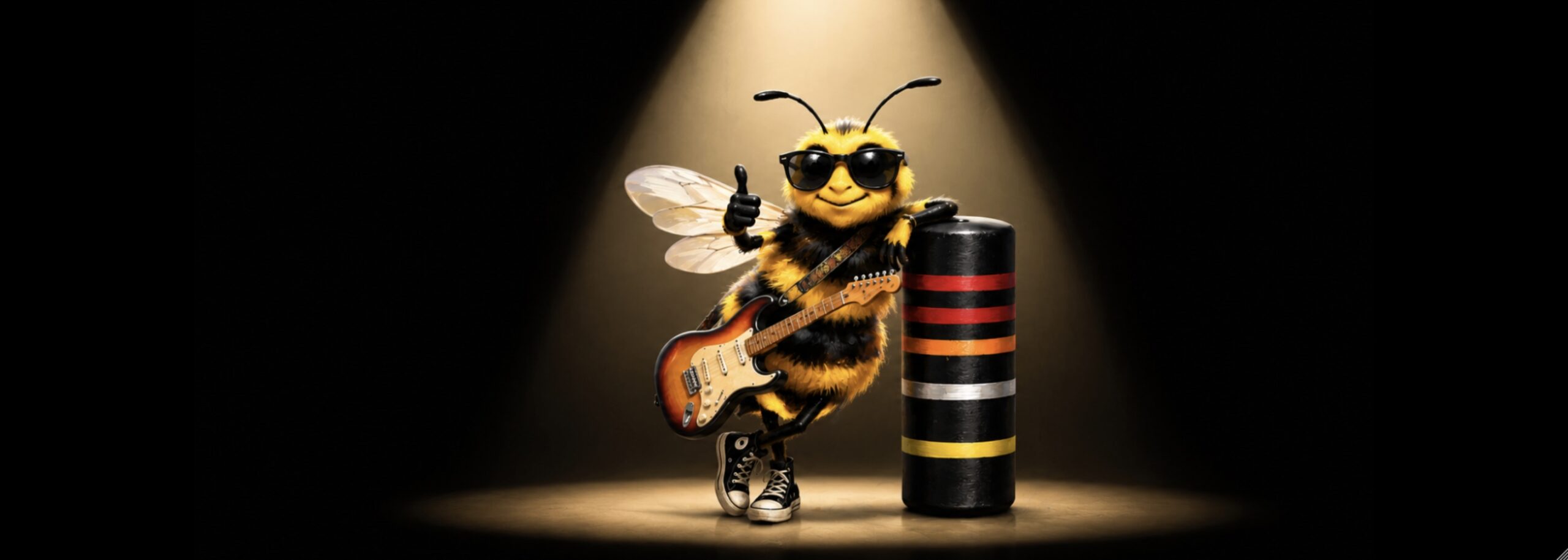
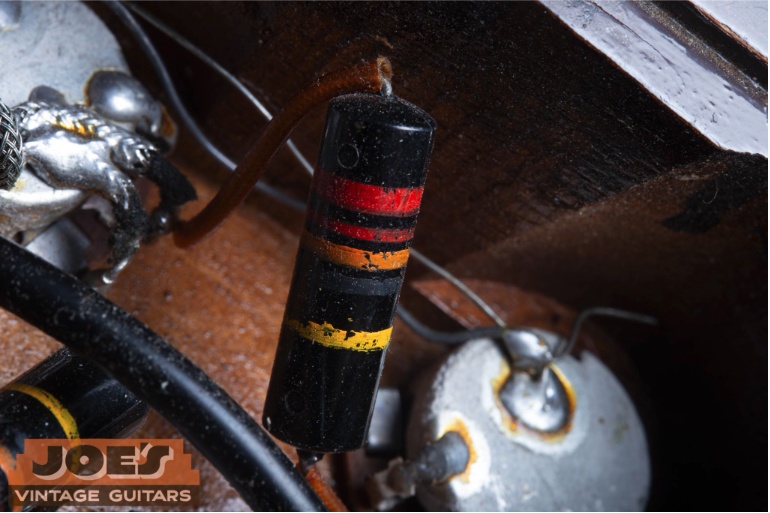
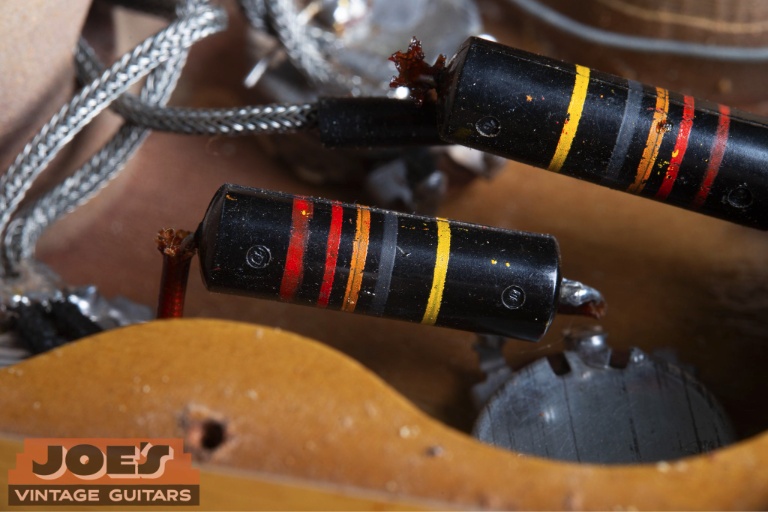
Sprague built the striped ones from about 1954 to 1960. The colored bands are a standard NEMA code, the same idea as resistor bands, and the stripes against the dark body are where the bumblebee nickname comes from. In 1960 Sprague dropped the stripes and switched to printed markings on the shell. Those are what people call Black Beauties.
So a striped cap and a printed cap can be the same part number doing the same job, separated by which side of 1960 they were made on. If somebody tells you a Black Beauty is a lesser capacitor than a bumblebee, ask them which year they mean. The construction changed more than once inside that decade, and the nickname tracks the printing rather than the guts.
You’ll also see the claim that bumblebees went to manufacturers like Gibson while Black Beauties went to the repair trade. Treat that as unsettled. The date-based account is the one that holds up against the components actually found in dated guitars.
The Paper-In-Oil Part Is Half True
This is the claim worth the most money and it’s the one people are loosest with.
Sprague’s own literature called these “Extended-Foil Paper Capacitors.” Not paper-in-oil. That phrase came later, largely from the people selling them.
The early striped ones are aluminum foil, kraft paper, and oil, which is what everyone means by paper-in-oil. But the line didn’t stay there. Mylar film construction showed up at the end of the 1950s, and the 160P Di-Film that ran from about 1960 to 1970 uses a dual dielectric of kraft paper and film. A large share of the .022 caps still circulating today are film with no oil in them at all.
That matters commercially. “Paper in oil” is doing a lot of work in listings for capacitors that aren’t paper in oil.
The common advice is that a true oil-filled example has a short metal tube at one end, described as the hole the oil went in through, and that a cap without the tube is film. It’s a useful sorting rule and I’d still look for the tube. But be aware the vintage capacitor documentation people argue that nub isn’t a fill hole at all, it’s the outer foil indicator. Which brings us to the one part of this that changes how your guitar behaves.
The Outside Foil, Which Actually Does Something
These are rolled capacitors. One lead connects to the inner foil and one to the outer foil, and the outer foil wraps around everything else like a shield.
Connect the outer foil lead to the lowest impedance path to ground, which in a guitar tone circuit means ground, and the capacitor shields itself and picks up less hum. Connect it backwards and the cap sits there as a small antenna in your control cavity. It isn’t polarity in the electrolytic sense and it won’t damage anything, but it’s free noise reduction and half the guitars I open have it backwards.
Old capacitors usually marked which end was the outer foil. Most modern manufacturers don’t bother, which is why this knowledge fell out of general circulation. If your cap isn’t marked, there’s a standard bench test: put a scope on its most sensitive vertical setting, connect across the cap, grip the body in your fingers, and note the induced 60Hz amplitude. Reverse the leads and repeat. The orientation showing the smaller induced signal has the outer foil on the grounded side.
If you’ve already done the work of shielding a cavity and sorting out your grounding, this is the last small piece of the same job.
Reading The Stripes
The bands are read left to right, with the wider gap at the right hand end. The first two give the significant digits, the third is a multiplier, and the remaining bands cover tolerance and voltage. The result is in picofarads.
A .022 microfarad cap is 22,000 picofarads, so the value reads as two, two, and a multiplier of one thousand. On a Gibson humbucker guitar of the period that’s the number you’re looking for, at 400 volts, which is a rating so far beyond what a passive guitar circuit produces that it’s decorative.
I’d rather point you at a printed decoder chart than have you take my word on the tolerance and voltage colors from memory. Pickguardian publishes a free Sprague bumblebee chart, and the Allied Electronic Data Handbook covers the code in general.
What Gibson Actually Put In The Guitar, By Year
The caps changed several times inside one decade, so “vintage correct” is meaningless until somebody names a year.
- Early to mid 1950s: Grey Tigers are the common ones in Les Pauls and other Gibsons.
- From roughly 1956: Sprague Black Beauty in paper-in-oil construction starts showing up. These are the striped bumblebees, .022 microfarad at 400 volts on the humbucker guitars.
- End of the decade into 1960: mylar construction arrives.
- After that: ceramic disc capacitors, which then stay in production guitars for decades.
A 1956 Les Paul and a 1961 Les Paul are both vintage and they do not have the same capacitor in them. Anybody selling you one cap as correct for the whole era hasn’t thought about it very hard.
Why An Old Cap Might Measure Different, And It Isn’t The Oil
Humbucker Soup has already made the case that the value of the capacitor is what matters and the construction mostly doesn’t. I agree with that, and I want to add the part that explains why people keep hearing something anyway.
A capacitor marked .022 was never exactly .022. Tolerances on these ran loose, commonly 10 or 20 percent, so a cap could leave the factory anywhere from about .0176 to .0264 and be entirely within spec. Then it sat in a guitar for sixty five years. Paper dielectrics absorb moisture, values drift, and old paper caps can develop leakage that a modern film cap won’t.
So when somebody swaps a vintage cap in and hears a difference, there’s a decent chance they’re right, and a decent chance the reason is that they just installed a capacitor that measures .027 instead of .022. That’s a real change in where the tone control starts working, and you can get the same result from a new capacitor for a dollar by picking a different value on purpose.
The practical version: put a meter on any vintage cap before you spend money on it. If the seller won’t give you a measured value, that tells you something.
What Bumblebee Capacitors Cost, And Why Guitars Get Stripped
Reproductions built to the original construction, hand wound and oil impregnated, sell in the tens of dollars for a matched pair. Gibson sells a Historic reissue two pack of its own. Original pulls run substantially higher, and the premium is entirely about provenance rather than measurable performance. $300-400 might seem absurd for a pair of capacitors to most people, but to someone restoring a guitar worth $350,000, it’s a small price to pay.
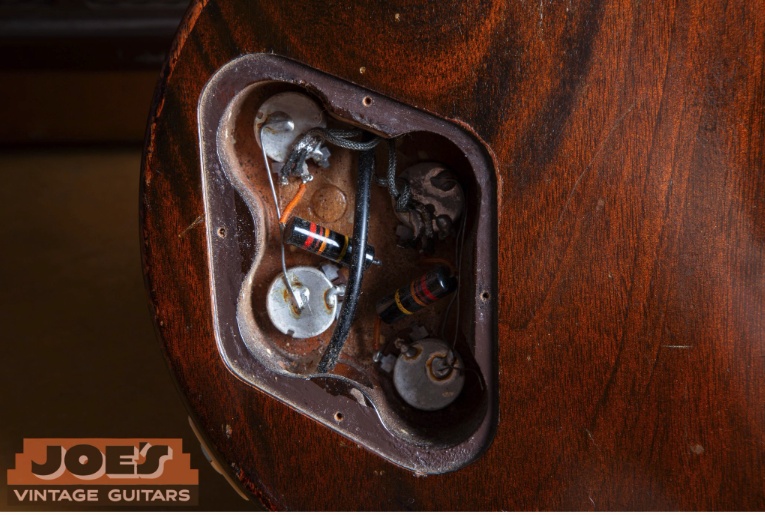
Here’s the part I care about as a dealer. That price gap is exactly why so many vintage guitars turn up today with reproduction harnesses in them and the original parts long gone. Somebody worked out that the capacitors were worth more separately than attached, and a guitar that had been intact for sixty years stopped being intact.
On a collectible instrument the untouched cavity is part of what you’re being paid for, and on the models where that premium is largest it’s a meaningful share of the guitar’s value. If you pull an original cap, keep it. Bag it, label it, tape it inside the case. A guitar that arrives with its original parts in a bag is worth substantially more than the same guitar without them, and the difference is far larger than what the loose cap would have brought you.
Buying a Bumblebee Capacitor Without Getting Burned
A loose capacitor has no serial number and no provenance. Almost nothing about a “1959 bumblebee” listing is verifiable, which is precisely why sellers assert the year so freely.
What you can actually check:
- Measured capacitance. Ask for it. A seller who has tested the cap will tell you; one who hasn’t is selling a story.
- Construction against the claimed date. Striped body means pre-1960 printing. Look for the metal nub at one end if the listing claims oil filled.
- The bands against the claimed value. A cap sold as .022 should read as such.
- Age that matches everywhere. The people making reproductions disclose exactly what they are, and some sell them pre-aged. Once an aged repro enters the used market as a loose part, that disclosure doesn’t travel with it.
- Whether you need it at all. If the goal is tone rather than originality, a new capacitor in the value you want will do the job for a couple of dollars.
Common Questions About Bumblebee Capacitors
Will a bumblebee make my guitar sound like a ’59 Les Paul? No. The tone capacitor is only meaningfully in the circuit as you roll the tone control down. At full tone you’re mostly not hearing it at all.
Is paper-in-oil better than film or ceramic? There’s no accepted electrical explanation for why the dielectric would matter in a passive guitar tone circuit, and plenty of people hear a difference anyway. What’s measurable is value and tolerance, so start there before spending on construction.
My vintage cap measures way off. Is it bad? Not necessarily. It may have left the factory off, and it has had decades to drift. Decide by what you want the tone control to do, not by what’s printed on the shell.
Does the orientation really matter? For noise, yes, and it costs nothing to get right. For tone, no.
What value should I use if I’m not chasing originality? .022 microfarad is the traditional humbucker value and .047 the traditional single coil value, but those are starting points rather than rules.